🐆
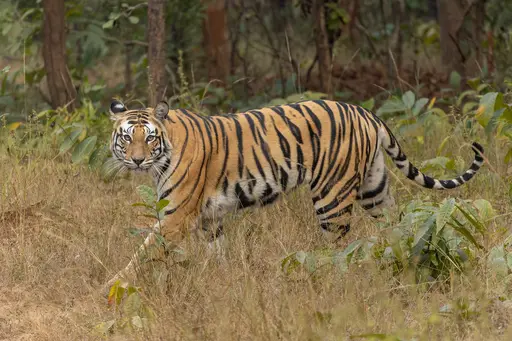
Bengal tiger
The Bengal tiger is a population of the Panthera tigris tigris subspecies. It ranks among the largest of wild cats. It is distributed from India, southern Nepal, Bangladesh, Bhutan to Southwestern China. Its historical range extended to the Indus Basin until the early 19th century, and it is thought to have been present in the Indian subcontinent since the Late Pleistocene about 12,000 to 16,500 years ago. It is threatened by poaching, habitat loss and habitat fragmentation.
Length
2.3 m
Weight
250 kg
Lifespan
25 yrs
Top Speed
65 km/h
Jump
—
Loudness
110 dB
Where Bengal tiger ranks
#22 of 70 · Fastest Land Animals
#22 of 76 · Fastest Mammals
#30 of 123 · Biggest Land Carnivores
#46 of 122 · Fastest Animals
#46 of 122 · Slowest Animals
#62 of 225 · Longest Lived Mammals
#63 of 274 · Heaviest Land Animals
#66 of 225 · Smallest Mammals
#67 of 274 · Biggest Land Animals
#95 of 435 · Heaviest Animals
#95 of 435 · Lightest Animals
#106 of 435 · Longest Living Animals
#106 of 435 · Shortest Lived Animals
#114 of 435 · Biggest Animals
#114 of 435 · Smallest Animals
🔎 Fun facts
✓
Masai giraffes are the tallest land animals, with males reaching up to 5.9 meters in height.
✓
Their distinct coat pattern consists of irregular, jagged spots, helping them camouflage in the wild.
✓
Masai giraffes can run at speeds of up to 60 km/h over short distances.
✓
A giraffe’s neck has the same number of vertebrae as a human’s—just seven, but each can be up to 25 cm long.
✓
Masai giraffes use their 45 cm-long tongues to strip leaves from thorny acacia trees.
✓
Despite their height, giraffes only need 5 to 30 minutes of sleep per day, often taken in short naps.
✓
Bengal tigers are the largest tiger subspecies, with males weighing up to 250 kilograms.
✓
A Bengal tiger’s roar can be heard up to 3 kilometers away.
✓
Each tiger has a unique stripe pattern, much like human fingerprints.
✓
Bengal tigers are excellent swimmers and can swim long distances to hunt or cross rivers.
✓
They are primarily solitary animals, marking large territories with scent markings.
✓
Bengal tigers have night vision six times better than humans, making them formidable nocturnal hunters.
Character
🦫 mammal 🌍 land 🍖 carnivore
📚 Description and image are reused from Bengal tiger on Wikipedia, published under the CC BY-SA 4.0 license. This AnimalRanking page is likewise published under CC BY-SA 4.0.