🐻
Polar bear
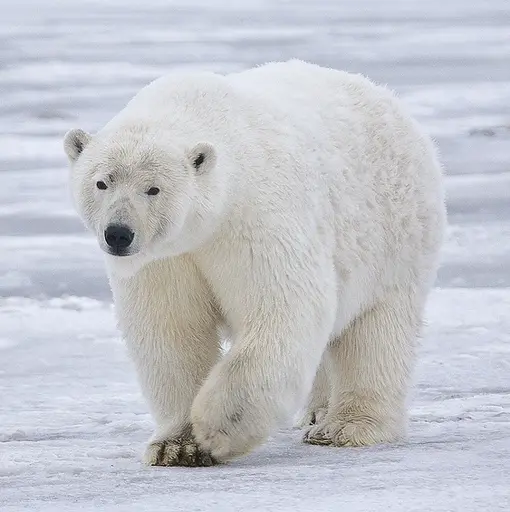
The polar bear is a large bear native to the Arctic and nearby areas. It is closely related to the brown bear, and the two species can interbreed. The polar bear is the largest extant species of bear and land carnivore by body mass, with adult males weighing 300–800 kg (660–1,760 lb). The species is sexually dimorphic, as adult females are much smaller. The polar bear is white or yellowish-furred with black skin and a thick layer of fat. It is more slender than the brown bear, with a narrower skull, longer neck and lower shoulder hump. Its teeth are sharper and more adapted to cutting meat. The paws are large and allow the bear to walk on ice and paddle in the water.
Length
3.4 m
Weight
900 kg
Lifespan
25 yrs
Top Speed
40 km/h
Jump
—
Loudness
—
Where Polar bear ranks
#17 of 123 · Biggest Land Carnivores
#22 of 274 · Heaviest Land Animals
#32 of 274 · Biggest Land Animals
#32 of 71 · Biggest Aquatic Animals
#33 of 225 · Smallest Mammals
#38 of 435 · Heaviest Animals
#38 of 435 · Lightest Animals
#46 of 70 · Fastest Land Animals
#48 of 76 · Fastest Mammals
#62 of 225 · Longest Lived Mammals
#65 of 435 · Biggest Animals
#65 of 435 · Smallest Animals
#78 of 122 · Fastest Animals
#78 of 122 · Slowest Animals
#106 of 435 · Longest Living Animals
#106 of 435 · Shortest Lived Animals
🔎 Fun facts
✓
Polar bears are the largest land carnivores, with adult males weighing up to 700 kilograms.
✓
They have a thick layer of fat and dense fur that insulates them from the cold Arctic temperatures.
✓
Polar bears are excellent swimmers and can cover distances of up to 100 kilometers in search of food.
✓
Their white fur helps them blend in with the snowy environment, while their black skin absorbs heat from the sun.
✓
Polar bears primarily hunt seals, using their powerful sense of smell to detect them from miles away.
✓
Due to climate change, polar bears are increasingly endangered as the ice they depend on for hunting is melting.
Character
🦫 mammal 🌍 land 🌊 aquatic 🍖 carnivore
📚 Description and image are reused from Polar bear on Wikipedia, published under the CC BY-SA 4.0 license. This AnimalRanking page is likewise published under CC BY-SA 4.0.